Poem-a-Day April 13: The Gorgeous Nothings

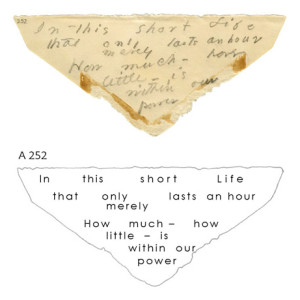
Dickinson_GorgeousNothings_252all
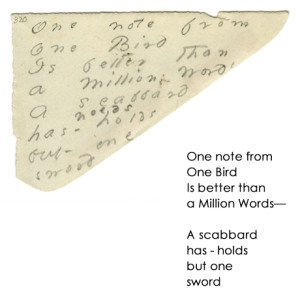
Dickinson_GorgeousNothings_320all


Hello Friends,

Today’s jottings on the backs of envelopes are the original handwriting of Emily Dickinson — coming to you because of a gift given to me: Cathy gave me a copy of The Gorgeous Nothings, a beautiful reproduction of Emily Dickinson manuscripts released at the end of 2013. Dickinson experiments with the shape of the page in these works — there’s not a regular rectangle in the bunch — like the flap of envelope 252 above follows the taper of the poem from a longer line to a single word.

Dickinson then nearly runs out of room to write “Words” in the righthand taper of envelope 320 — I don’t think Dickinson actually believes that each word holds only one possible meaning, like a scabbard holds only one sword. For instance, she’s quite aware here that she’s using “One Bird” to embody all the wonders of music and the natural world. I think she means that words are as much manmade tools as swords are, and feeble in comparison to their task of trying to capture the beauty of the world around us, trying to capture even just one note of one bird.

E.E. Cummings has a line about “one bird” as well — it makes me wonder if Cummings could’ve ever read Dickinson’s envelope 320. He says, “I’d rather learn from one bird how to sing / than teach ten thousand stars how not to dance.” There’s something about teaching stars not to dance that sounds a bit like putting each star away in its scabbard …which makes me think of a dozen other poems. Ok, better wrap this up:

The release of The Gorgeous Nothings coincided with the release of a vast, if not quite as gorgeous, new online archive of Emily Dickinson’s original manuscripts at EDickinson.org/ — explore if you’re interested! It could prove to be an exciting model for more libraries, trusts, and academic institutions to collaborate with each other in compiling their original manuscript holdings in the future.

I hope you’re enjoying National Poetry Month!
— Ellen

Poem-a-Day April 12: Disappearing

Tigers
for Erik Lemke (1979 – 2012)
1.

A hummingbird flies into a window
that looks like the sky. Everything around here

looks like the sky. The sky looks tiger striped.
They call that kind of cloud

something. I know somebody
who knows about clouds. I could find

out the name. Everything around here
has a name.

2.

The hummingbird fell to the deck. My husband picked it up.

—What did it feel like in your hand?
—Nothing. It felt like nothing.
—Where is it now?
—Gone.
—Dead?
—Not dead. It flew away. It disappeared and it disappeared again.

3.

I’ll tell you a joke. A hummingbird flew into a window…

I’ll tell you another joke. Treachery,
we were friends once.

4.

In dreams the bird
weighs more, so you can feel it

when you pick it up. So when
it dies it seems

like something actually happened.
It’s a word

bound
around your hand and a sign

at the stripped road.
A mylar star on a plastic stick

tied to the sign.
Blacktop. Post. A fat star’s

wrinkles taut. It’s stuffed.

It’s shining.
There’s going

to be a party around here somewhere.
The bird weighs nothing waits nowhere.

The sky looks like a window and it flies right through.


Hello Friends,

A hummingbird got trapped in the castle stairwell today. Dead or nearly dead, we took it to a sheltered spot outside, and Bethany covered it with flowers.

A literal hummingbird flying into a window is just one reading of Melissa Ginsburg’s 2013 poem. Ginsburg highlights the briefness of a fellow poet’s life by including the years of his birth and death in her dedication “for Erik Lemke (1979 – 2012)” — a suggestion to the reader, along with the vastness of the sky, that this poem is bigger than one bird. The hummingbird seems to represent the kind of death that is so sudden and nonsensical, it doesn’t seem entirely real — even as you grasp it, it seems to have no weight.

Readers have puzzled over Ginsburg’s choice of “Tigers” for the title of this poem — I think it’s a title that’s not entirely for us; it’s in part something meaningful to Melissa Ginsburg and Erik Lemke on a personal level. But to my ear, there is also something of “tigers in red weather” in it — a line from a famous poem by Wallace Stevens, “Disillusionment of Ten O’Clock.” To me, there’s also something of Craig Arnold in this poem — a poet whose death in 2009 was also so sudden and nonsensical, it doesn’t seem entirely real: he disappeared into a volcano in Japan, leaving no body, but a great deal of weight, behind.

— Ellen
Poem-a-Day April 11: Eyes Close, Words Open

Hello Friends,

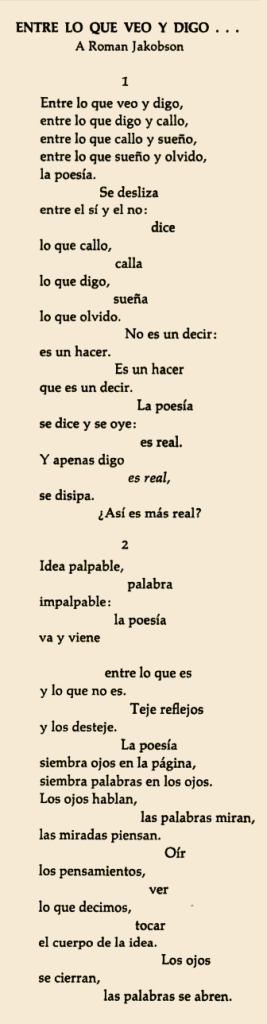
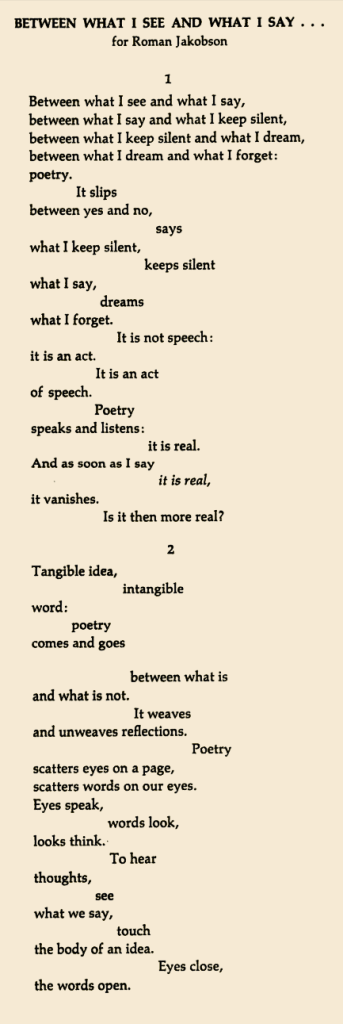
The poet, Mexican Ambassador, and Nobel Laureate Octavio Paz wrote today’s poem for a memorial service for the critic and linguist Roman Jakobson, who passed away in 1982. “Entre Lo Que Veo Y Digo . . . / Between What I See and What I Say . . .” is also included in his 1987 collection Árbol Adentro / A Tree Within. The accompanying English translation is by Paz’s longtime collaborator and translator Eliot Weinberger.

¡buen provecho!
Ellen

OctavioPaz_BetweenWhatISay_Espanol OctavioPaz_BetweenWhatISay_English

Poem-a-Day April 10: Hands Wide Shut

Prayer

Dear Lord
Show me
The way—
Take
My heart
And throw
It away

Lord, take
My heart
And throw
It out

Lord, throw
My heart
Way out

 
Hello Friends,

When you read poet Robert Glück’s “Prayer,” do you picture hands closed in prayer, or hands wide open in prayer?

There’s something of Kay Ryan in the cadence over these short choppy lines. I’m also reminded of a handful of other prayer-related poem-a-days from past Aprils: Julia Vinograd’s “Ballad,” Maia McAleavey’s “This is not a love poem, 1895,” and Kathleen Peirce’s “Object Tension.”

I hope you’re enjoying National Poetry Month! If not, don’t forget to submit your unsubscribe request in the form of a heroic couplet.

Thanks,
Ellen

Poem-a-Day April 9: this cough i cough

what does a liver know of peace
or spleen. kidneys. ribs. be still my soul.
how does a city broker its disease
within the confines of a borough, where control
limps tepid-like carrying a parasol
of hurts, hurting, hurted, hurtful croons
stranded in measured arenas without pulpits or spittoons.

***

sister tell me about this cough i cough
all of my skin cradled in this cough
my body ancient as this white cough, i cough
all day and night i’m haunted by this cough,
a snake rattles in my throat this cough, i cough
a scream embalms my chest with cough
sister an echo surrounds my lungs with this cough, i cough.

 
Hello Friends,

Sonia Sanchez’s Does Your House Have Lions? (1997) is a book-length dialogue between sister, brother, father, mother, and ancestor voices. The excerpts above are both in the voice of the brother, who is dying of AIDS.

Sanchez takes her ear for contemporary spoken word and applies it to a poetic form at least as old as Chaucer, the Rhyme Royal: Does Your House Have Lions? is written entirely in seven line stanzas with an A-B-A-B-B-C-C rhyme scheme.

Does Your House Have Lions? was also featured for poem-a-day way back on April 24, 2007.

— Ellen

Poem-a-Day April 8: ants and ants

Anxieties

It’s like ants
and more ants.

West, east
their little axes

hack and tease.
Your sins. Your back taxes.

This is your Etna,
your senate

of dread, at the axis
of reason, your taxi

to hell. You see
your past tense—

and next? A nest
of jittery ties.

You’re ill at ease,
at sea,

almost in-
sane. You’ve eaten

your saints.
You pray to your sins.

Even sex
is no exit.

Ah, you exist.


Hello Friends,

Today’s poet, Donna Masini, credits her contemporary Terrance Hayes (featured for poem-a-day April 28, 2011) with introducing her to this poetic exercise in anagrams: Every single line in Masini’s “Anxieties” ends with a word that can be spelled using only the letters A-N-X-I-E-T-I-E-S. Those “ants” and “ants” are quite literally crawling out of “Anxieties.” The result is a poem that doesn’t necessarily convey the exact formula of its form, but your ear does pick up a more general sense of remixing variations on the same sounds.

If you have an interest in anagrams (or porn, or supreme court justices), may I also highly recommend the insanely brilliant “It’s Smut” by Kevin McFadden (featured for poem-a-day April 26, 2010).

Happy National Poetry Month!

Ever anxiously yours,
Ellen

Poem-a-Day April 7: This is the forest primeval

Hello Friends,

There’s something very special about holding a 114-year-old book in your hands, that visceral reminder of how long these words have lasted, and how precious these words’ surviving is.

This 1900 edition of Henry Wadsworth Longfellow’s (167-year-old) epic poem Evangeline that Bethany gave me has been in Long Beach at least since its previous owner inscribed it in pencil in 1926. A number of poems this month will come from books that were gifts from one of you on this poetry list, actually — the most precious books in my poetry collection.

Evangeline cover
I wish that every one of you could read today’s poem from this copy I’m holding. There’s nothing quite like it. But since the current poem-a-day budget doesn’t cover that kind of travel expense, nor purchase and shipping costs for that many 114-year-old copies, we’ll have to make do with the email equivalent.

Longfellow’s epic is a very readable page-turner: His title character, Evangeline, loses her family, her childhood home, everything she’s ever known, when the British forcibly remove the French population from Acadia (now Nova Scotia). We then get a historical tour of pre-Revolutionary America that covers territories from Louisiana to Nebraska to Michigan to Pennsylvania, as Evangeline spends her life searching towns where scattered survivors from Acadia may have settled, trying to find her long-lost love Gabriel.

Today’s poem is also an exercise in whether the printed page matters, especially for poetry. Whether font matters. Margins. Page breaks. The poem that came before a poem or after a poem when it was bound as a collection. A poet may not have personal control over all those aspects of print, but do they still impact how you read a poem? Take a look at the photos below of my 1900 copy of the famous opening lines of Evangeline, and then check out the 2014 version of Evangeline on poets.org, the website of the Academy of American Poets, who officially bring you National Poetry Month.

Make an argument for how these are or are not the same poem. Make an argument for whether paper books, electronic books, or some other form of the written or spoken word will survive the longest on this earth. What does a 114-year-old copy of a book written in 2014 look like?


evangeline_pg1
evangeline_spread1
evangeline_spread2

Poem-a-Day April 6: There is no chance

Friends,

I picked out “Sunflower Sonnet Number Two” as a favorite of mine from an old edition of June Jordan’s Things that I Do in the Dark, only to later find that Adrienne Rich picked out the same sonnet in her introduction to Directed By Desire: The Collected Poems of June Jordan (2005), published after Jordan’s death in 2002. That was a fun moment for me — to think Adrienne Rich and I had similar taste in June Jordan poetry. And I’m going to use that Adrienne Rich introduction to justify cheating just a little bit today and sneaking in two poems, both quoted in Rich’s introduction: I believe Jordan wrote these two poems years apart, but they share a theme of the fluctuation of distance and closeness, impermenance and certainty, in long-term relationships.

Enjoy.
Ellen


SUNFLOWER SONNET NUMBER TWO

Supposing we could just go on and on as two
voracious in the days apart as well as when
we side by side (the many ways we do
that) well! I would consider then
perfection possible, or else worthwhile
to think about. Which is to say
I guess the costs of long term tend to pile
up, block and complicate, erase away
the accidental, temporary, near
thing/pulsebeat promises one makes
because the chance, the easy new, is there
in front of you. But still, perfection takes
some sacrifice of falling stars for rare.
And there are stars, but none of you, to spare.

***

POEM NUMBER TWO ON BELL’S THEOREM,
OR THE NEW PHYSICALITY OF LONG DISTANCE LOVE

There is no chance that we will fall apart
There is no chance
There are no parts.


P.S. You don’t need a physics background to understand this poem, but for the curious: “Bell’s Theorem” refers to a debated concept in quantum physics — something about how an action on one subatomic particle can affect another subatomic particle instanteously, even if the particles are universes apart.* Language that physicists (including Einstein) use to talk about this particular theorem includes “quantum entanglement,” “non-locality,” and ”spooky actions at a distance” — just the sort of poetic phrases that would catch the attention of a romantic like Jordan in a physics article or textbook.

For me, knowing the physics reference does make a difference in how I read Jordan’s use of the phrase “There is no chance.” That brazen, very American “I have 100% control over my own (relationship’s) destiny” attitude is still there. But there’s also a more literal, physical (subatomic-particle-level physical) reading — an almost opposite feeling of giving 100% control over to the universe and trusting in its mysteries we only scratch the surface of understanding.

* Physicists on this email list: Please speak up and clarify if I’ve misrepesented Bell here!

Poem-a-Day April 5: Robin knows it best

The Secret

We have a secret, just we three,
The robin, and I, and the sweet cherry-tree;
The bird told the tree, and the tree told me,
And nobody knows it but just us three.

But of course the robin knows it best,
Because she built the—I shan’t tell the rest;
And laid the four little—something in it—
I’m afraid I shall tell it every minute.

But if the tree and the robin don’t peep,
I’ll try my best the secret to keep;
Though I know when the little birds fly about
Then the whole secret will be out.


Hello Friends—

“The Secret” is written by Anonymous (of course, who else?). You can find it in The Golden Book of Poetry (1947). This poem is one of my favorite examples of withholding an expected rhyme — that moment when your ear hears “nest” without the poet ever writing it down. You’ve encountered this technique before: Alexander Pope uses it in “An Essay on Criticism,” The Killers use it in “Mr. Brightside.” What’s special about the use of withheld rhyme here in “The Secret” is that it so perfectly mimics the subject matter — that “I’m afraid I shall tell it every minute” feeling when a secret is just bursting through all your seams.

Happy Birthday, Robin and Megan! And to anyone else whose birthday the little bird didn’t tell me about.

And of course a Happy National Poetry Month!

Cheers,
Ellen

Poem-a-Day April 4: A Blessing for One Who is Exhausted

A Blessing for One Who is Exhausted

When the rhythm of the heart becomes hectic,
Time takes on the strain until it breaks;
Then all the unattended stress falls in
On the mind like an endless, increasing weight,

The light in the mind becomes dim.
Things you could take in your stride before
Now become laborsome events of will.

Weariness invades your spirit.
Gravity begins falling inside you,
Dragging down every bone.

The tide you never valued has gone out.
And you are marooned on unsure ground.
Something within you has closed down;
And you cannot push yourself back to life.

You have been forced to enter empty time.
The desire that drove you has relinquished.
There is nothing else to do now but rest
And patiently learn to receive the self
You have forsaken for the race of days.

At first your thinking will darken
And sadness take over like listless weather.
Then flow of unwept tears will frighten you.

You have traveled too fast over false ground:
Now your soul has come to take you back.

Take refuge in your senses, open up
To all the small miracles you rushed through.

Become inclined to watch the way of rain
When it falls slow and free.

Imitate the habit of twilight,
Taking time to open the well of color
That fostered the brightness of day.

Draw alongside the silence of stone
Until its calmness can claim you.
Be excessively gentle with yourself.

Stay clear of those vexed in spirit.
Learn to linger around someone of ease
Who feels they have all the time in the world.

Gradually, you will return to yourself,
Having learned a new respect for your heart
And the joy that dwells far within slow time.


— John O’Donohue, from To Bless the Space Between Us: A Book of Blessings (2008)