Poem-a-Day April 27: Rich

The Mirror in Which Two Are Seen as One

1.

She is the one you call sister.
Her simplest act has glamour
as when she scales a fish the knife
flashes in her long fingers
no motion wasted or when
rapidly talking of love
she steel-wool burnishes
the battered kettle

Love apples cramp you sideways
with sudden emptiness
the cereals gutting you, the grains
ripe clusters picked by hand
Love: the refrigerator
with open door
the ripe steaks bleeding
their hearts out in plastic film
the whipped butter, the apricots
the sour leftovers

A crate is waiting in the orchard
For you to fill it
Your hands are raw with scraping
The sharp bark, the thorns
Of this succulent tree
Pick, pick, pick
this harvest is a failure
the juice runs down your cheekbones
like sweat or tears

2.

She is the one you call sister
you blaze like lightning about the room
flicker around her like fire
dazzle yourself in her wide eyes
listing her unfelt needs
thrusting the tenets of your life
into her hands

She moves through a world of India print
her body dappled
with softness, the paisley swells at her hip

walking the streets in her cotton shift

buying fresh figs because you love them
photographing the ghetto because you took her there

Why are you crying dry up your tears
we are sisters
words fail you in the stare of her hunger
you hand her another book
scored by your pencil
you hand her a record
of two flutes in India reciting

3.

Late summer nights the insects
fry in the yellowed lightglobe
your skin burns gold in its light
In this mirror, who are you? Dreams of the nunnery
with its discipline, the nursery
with its nurse, the hospital
where all the powerful ones are masked
the graveyard where you sit on the graves
of women who died in childbirth
and women who died at birth
Dream of your sister’s birth
your mother dying in childbirth over and over
not knowing how to stop
bearing you over and over

your mother dead and you unborn
your two hands grasping your head
drawing it down against the blade of life
your nerves the nerves of a midwife
learning her trade

———————————————

Hello Friends —

The poet Adrienne Rich had a younger sister, and also considered her feminist and civil rights activist colleagues sisters — famously refusing to accept the National Book Award in 1974 alone, instead bringing fellow nominees Audre Lorde and Alice Walker on stage with her to accept the award “on behalf of all women.” In 1997, she also famously turned down the White House’s National Medal of Arts, in protest of efforts to defund the National Endowment for the Arts, stating, “Art means nothing if it simply decorates the dinner table of the power which holds it hostage.” Rich passed away one month ago, on March 27, 2012, so it’s up to those that continue after her now to ensure art serves as a tool of justice and not just decoration.

Hear Alice Walker discuss Rich and the 1974 National Book Award, and hear Adrienne Rich read her 1997 National Medal of Arts refusal letter in the Democracy Now video embedded below:

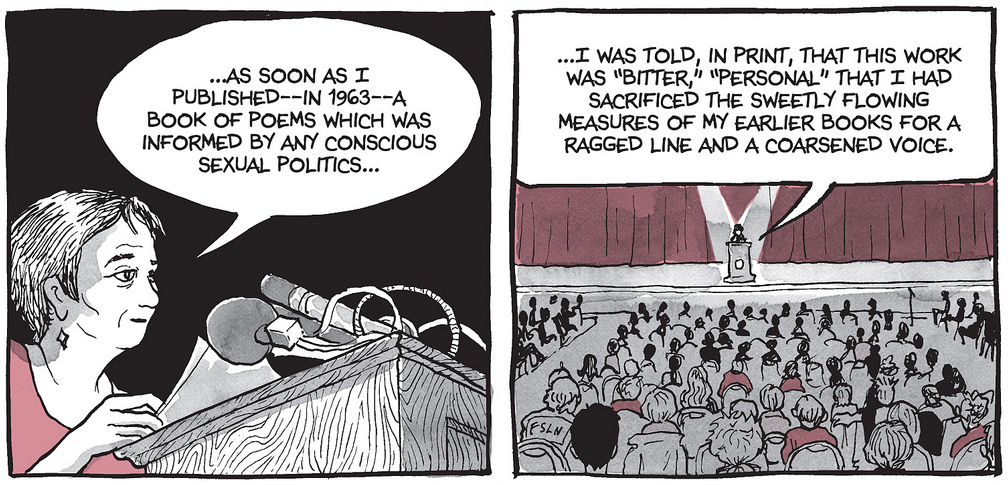
And from Alison Bechdel:
Adrienne Rich by Alison Bechdel

Enjoy.
Ellen

P.S. Thank you to Bonnie for choosing this poem to send out in Rich’s honor.

Poet Adrienne Rich was also featured for Poem-a-Day April 25, 2008.

Poem-a-Day April 26: Blame Picasso.

Hello Friends —

I’m happy to report Operation Distribute Pocket Poems in Long Beach was a success! I hope you enjoyed Poem in Your Pocket Day in your own way.

Today’s poem is by the unofficial poet laureate of Berkeley, California, Julia Vinograd — who has been blowing bubbles and recording street life on Telegraph Avenue for the past 40 years. She also holds an MFA from the University of Iowa (that’s like the poetry equivalent of an MBA from Harvard, very fancypants prestigious).

Sometimes reading hurts —
Ellen

WHAT PICASSO DID TO ME

I got this big thick heavy hardcover Picasso book
with pictures, platitudes, basically poundage
and carrying it home I pulled a muscle in my wrist.
My right hand’s gone cubist,
angles askew as Picasso’s women
crying into pointed teeth and sideways jaws.
My wrist throbs with the last scream of Guernica;
I’ve become too historical to haul myself into a bus
or pour tea,
I even use my other hand in the bathroom.
Picasso’s painted me into a corner
where the blind man sits
pulling my muscle on his blue guitar.
In the bullring my wrist’s already trampled
into the bloody sand
among thrown Spanish roses and oranges.
Neither bull nor matador know I’m alive
but I am alive, my wrist hurts.
The wars got into my wrist,
it’s all in the wrist.
Picasso’s using my wrist to paint
curly women and naked minotaurs
and I want my wrist back.
I’d like to throw the book at Picasso,
I want out of his book that bit me,
I’ve got an ace bandage and a grudge
while cubist tears roll down billboard faces.
So the paint won’t leak out. Or the pain.
Or the world spilling out of my wrist, hurting.

Is that a poem in your pocket?

Hello Friends —

Tomorrow, Thursday April 26, is officially Poem in Your Pocket Day, brought to you by the Academy of American Poets — the same folks who bring you National Poetry Month, www.poets.org, and today’s subject line.

Poem in Your Pocket Day makes for an excellent excuse to spread the joy of Poetry Month to even more people! If you’ve never done it before, handing out poems on the street is very fun and rewarding. At first people will think you’re trying to hand them some promotional flyer they’ll then have to go to the trouble of finding a recycling bin for, but then they become pleasantly surprised to discover you’re giving them a little gift that asks nothing in return.

You can find today’s poem and other pocket-prone poems for your own Poem in Your Pocket Day celebration in print-your-own-at-home PDF format here. And here’s the best part: no one really knows, nor does it particularly matter, which day is actually Poem in Your Pocket Day — you can hand out poems to strangers any day, particularly any day in April.

Enjoy.
Ellen

Dust of Snow

The way a crow
Shook down on me
The dust of snow
From a hemlock tree

Has given my heart
A change of mood
And saved some part
Of a day I had rued.


“Dust of Snow” by Robert Frost was also featured for Poem-a-Day April 16, 2007 and Poem-a-Day April 4, 2010.
Poet Robert Frost was also featured for Poem-a-Day April 30, 2008.

Poem-a-Day April 24: O frabjous day!

O Frabjous Day, Friends!

As many of you know, I am of the opinion that the poem “Jabberwocky” ought to be read, aloud, at least once a year. Today my former co-workers sent me a video of themselves doing just that — thank you, Watershed; I’m really touched (miss you all! ::sniff::). There is even a Watershed custom board game featuring “Jabberwocky!”

You too can experience the Calloohity for yourselves: I challenge you to read “Jabberwocky” aloud to someone else today.

If you shy away from this challenge because you don’t know what half of the words mean, I refer you to Humpty Dumpty: “When I use a word, it means just what I choose it to mean — neither more nor less.”

With every poem, a reader in a sense chooses what you mean each of the poet’s words to mean. Reading “Jabberwocky,” especially out loud, simply requires you to make your choices of meaning more conscious acts. Reading aloud is a form of translation — you are translating the written “Jabberwocky” into a spoken “Jabberwocky.” Keith Lim has also compiled a lovely collection of translations of “Jabberwocky” — into languages ranging from Spanish and Japanese to C++ and Klingon.

Callay!
Ellen


Jabberwocky

‘Twas brillig, and the slithy toves
Did gyre and gimble in the wabe;
All mimsy were the borogoves,
And the mome raths outgrabe.

“Beware the Jabberwock, my son!
The jaws that bite, the claws that catch!
Beware the Jubjub bird, and shun
The frumious Bandersnatch!”

He took his vorpal sword in hand:
Long time the manxome foe he sought —
So rested he by the Tumtum tree,
And stood awhile in thought.

And, as in uffish thought he stood,
The Jabberwock, with eyes of flame,
Came whiffling through the tulgey wood,
And burbled as it came!

One two! One two! And through and through
The vorpal blade went snicker-snack!
He left it dead, and with its head
He went galumphing back.

“And hast thou slain the Jabberwock?
Come to my arms, my beamish boy!
O frabjous day! Callooh! Callay!”
He chortled in his joy.

‘Twas brillig, and the slithy toves
Did gyre and gimble in the wabe;
All mimsy were the borogoves,
And the mome raths outgrabe.


“Jabberwocky” by Lewis Carroll was also featured for Poem-a-Day April 19, 2010 and Poem-a-Day April 8, 2007 — and for a Watershed Tues@2 staff meeting every April since the company’s founding in 2007.

Poem-a-Day April 23: fearful bravery

Hello Friends —
So there’s this poet William Shakespeare (you might’ve heard of him — it’s his birthday today) who favored a literary technique called oxymoron for its ability to convey paradoxes in the human condition. “Fearful bravery” is an example of an oxymoron. A paradox it illustrates is that without fear, there is no bravery — for in order to be brave, we must have something worth fearing to be brave in the face of or overcome.
Enjoy.
Ellen


CAESAR:
Cowards die many times before their deaths;
The valiant never taste of death but once.
Of all the wonders that I yet have heard,
It seems to me most strange that men should fear;
Seeing that death, a necessary end,
Will come when it will come.—

Poem-a-Day April 22: Earth took of earth

Hello Friends —
For Earth Day this year: A poem from the earth to the earth, written in Old English circa 1000, author unknown. For me, the echo of a biblical “dust to dust” in this poem emphasizes the impossibility of clearly delineating a distinction between humans and the planet we inhabit.
Enjoy.
Ellen


Earth Took of Earth

Earth took of earth earth with ill;
Earth other earth gave earth with a will.
Earth laid earth in the earth stock-still:
Then earth in earth had of earth its fill.

***

Erthe Toc of Erthe

Erthe toc of erthe erthe wyth woh,
erthe other erthe to the earthe droh,
erthe leyde erthe in erthene throh,
tho hevede erthe of erthe erthe ynoh.


Poems in honor of Earth Day were also featured for Poem-a-Day April 21, 2007; Poem-a-Day April 22, 2008; Poem-a-Day April 22, 2009; Poem-a-Day April 22, 2010; and Poem-a-Day April 22, 2011.

Poem-a-Day April 21: 3,500 dead birds

Hello Friends —
Sometimes a story takes roost in a writer. Its unspokeness occupies a space in you, even in your sleep. The story keeps reminding you that it can’t tell itself, like a bird can’t speak English. For me, that feeling is what today’s poem by Jim Harrison is about.
Enjoy.
Ellen


Birds Again

A secret came a week ago though I already
knew it just beyond the bruised lips of consciousness.
The very alive souls of thirty-five hundred dead birds
are harbored in my body. It’s not uncomfortable.
I’m only temporary habitat for these not-quite-
weightless creatures. I offered a wordless invitation
and now they’re roosted within me, recalling
how I had watched them at night
in fall and spring passing across earth moons,
little clouds of black confetti, chattering and singing
on their way north or south. Now in my dreams
I see from the air the rumpled green and beige,
the watery face of earth as if they’re carrying
me rather than me carrying them. Next winter
I’ll release them near the estuary west of Alvarado
and south of Veracruz. I can see them perching
on undiscovered Olmec heads. We’ll say goodbye
and I’ll return my dreams to earth.


A large quantity of dead birds also featured prominently in Poem-a-Day April 24, 2011.

Poem-a-Day April 20: concrete island

Hello Friends —

Many of you may recall sometime in elementary or middle school writing a poem about the weather in the shape of a raindrop — your teacher probably gave you this exercise to teach you what poetry is. But think about this: humans invented rhyme and meter to make stories easier to memorize and re-tell orally, long before the written word. For an art form that originated as strictly spoken, that little elementary school raindrop poem is arguably a pretty radical departure — taking the poetic form all the way to its other extreme: an arrangement of words on the page so visual that it cannot be conveyed out loud; it requires the physical page.

You can think of today’s poem as a grown-up version of that popular visual poetic form, the concrete poem. “Manhattan” by Howard Horowitz first appeared in The New York Times on August 30, 1997. For those of you not familiar with this island covered largely in concrete, the content of Horowitz’s words corresponds to their location — so, for example, the unicorn tapestries in the Cloisters are located at the northern most tip of Manhattan Island, just as they are located at the northernmost tip of Horowitz’s page.

Enjoy.
Ellen

Poem-a-Day April 19, 2009 is another example of a concrete poem.

Poem-a-Day April 18: The days are beautiful.

Hello Friends —

My friend Kate’s birthday is September 11, and it is a beautiful birthday.

It’s been her birthday her whole life. One day in her teens, it became something else, to everyone else. But it’s still her birthday. It’s still a day. And days are vast — they contain so much, and so much that is beautiful.

I need an un-cursing, a de-jinxing, a filtering down to the beautiful — I need this poem today. I just couldn’t find another that would do. So with apologies to Kate, and to anyone else for whom this is a repeat, Ann Lauterbach‘s hum:


Hum

The days are beautiful
The days are beautiful.

I know what days are.
The other is weather.

I know what weather is.
The days are beautiful.

Things are incidental.
Someone is weeping.

I weep for the incidental.
The days are beautiful.

Where is tomorrow?
Everyone will weep.

Tomorrow was yesterday.
The days are beautiful.

Tomorrow was yesterday.
Today is weather.

The sound of the weather
Is everyone weeping.

Everyone is incidental.
Everyone weeps.

The tears of today
Will put out tomorrow.

The rain is ashes.
The days are beautiful.

The rain falls down.
The sound is falling.

The sky is a cloud.
The days are beautiful.

The sky is dust.
The weather is yesterday.

The weather is yesterday.
The sound is weeping.

What is this dust?
The weather is nothing.

The days are beautiful.
The towers are yesterday.

The towers are incidental.
What are these ashes?

Here is the hate
That does not travel.

Here is the robe
That smells of the night

Here are the words
Retired to their books

Here are the stones
Loosed from their settings

Here is the bridge
Over the water

Here is the place
Where the sun came up

Here is a season
Dry in the fireplace.

Here are the ashes.
The days are beautiful.


“Hum” by Ann Lauterbach was also featured for Poem-a-Day April 17, 2007 and Poem-a-Day April 21, 2009.